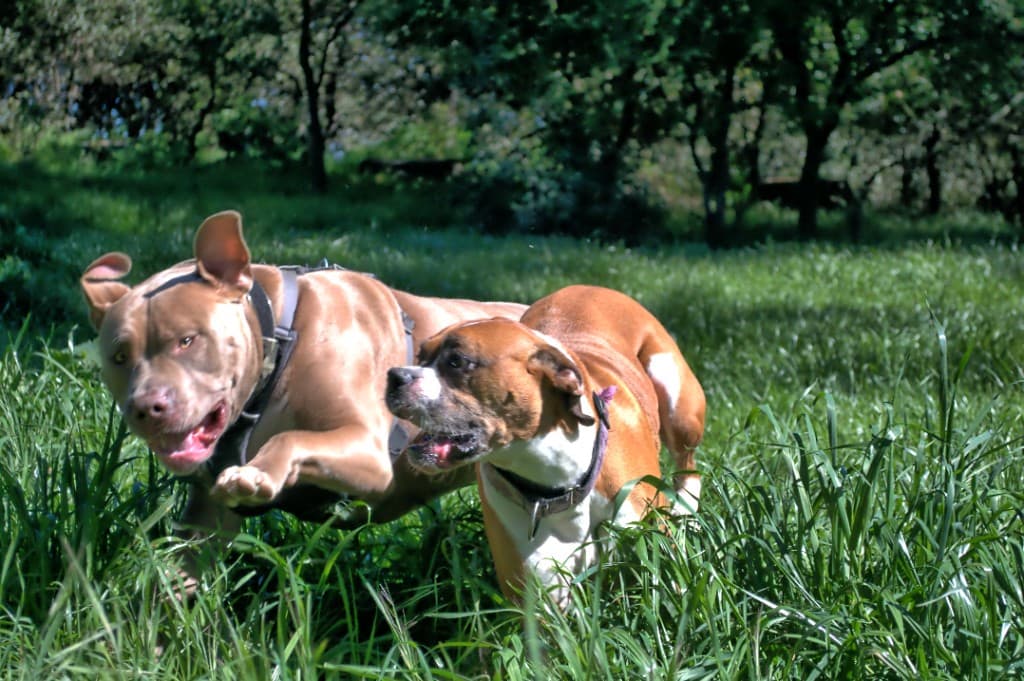
Being free to move and sniff makes dogs on average more optimistic and less stressed. Below is a short overview of what the research says.
“Is my dog allowed off-leash?” we hear often. In practice we notice that dogs who may safely move and sniff freely come home calmer on average — and behavioural research points the same way.
Sniffing makes dogs demonstrably more optimistic
The nose is to a dog what eyes are to us. In a well-known study by Duranton and Horowitz (2019), researchers let one group of dogs do daily “nosework” for two weeks (independently searching for hidden scents), while a control group did obedience exercises (heelwork). Afterwards they measured emotional state with a cognitive bias test — a validated way to measure whether an animal approaches the world more optimistically or pessimistically.
The result was clear: the dogs that were allowed to sniff approached an ambiguous situation faster and with more confidence. Nothing changed in the control group. The conclusion: giving dogs more time to use their nose and make their own choices improves their welfare.
“By giving dogs more ‘foraging time’ in which they use their sense of smell, they become more optimistic and their welfare improves.”
Off-leash = moving at their own pace
On a lead, the human sets the pace and the route. Research with GPS collars on off-leash dogs showed that dogs cover clearly greater distances under their own steam, at a higher and more varied pace than their owner — while most dogs simply stayed within a radius of about 150 metres of their owner.
The lead itself can build tension
On a lead a dog often cannot do what it would naturally do in a meeting: approach in an arc, turn away briefly, sniff calmly. Behaviourists speak of “leash reactivity”: dogs that bark or lunge at other dogs on a lead, but often respond more socially off-leash. What is firmly supported: freedom to sniff and move at their own pace improves emotional state; imposed restriction can trigger stress.
Off-leash still needs structure
Freedom only works safely when group, location and guidance are right. That is why we plan outings in defined nature areas, with experienced walkers who read group behaviour. That is what dog walking in Antwerp looks like with us — this article focuses on the why behind going off-leash.
Sources
- Duranton, C., & Horowitz, A. (2019). Let me sniff! Nosework induces positive judgment bias in pet dogs. Applied Animal Behaviour Science, 211, 61–66.
- Hauser, H., et al. (2021). Exploration Behavior of Pet Dogs During Off-Leash Walks. Animal and Veterinary Sciences, 9(6), 181–190.
- Bekoff, M. (2016). Why Dogs Belong Off-Leash: It's Win-Win for All. Psychology Today.
Interested in day trips?
Adventurous day trips with home pickup — €45/day (excl. VAT). During the intro we check together whether your dog fits the group.