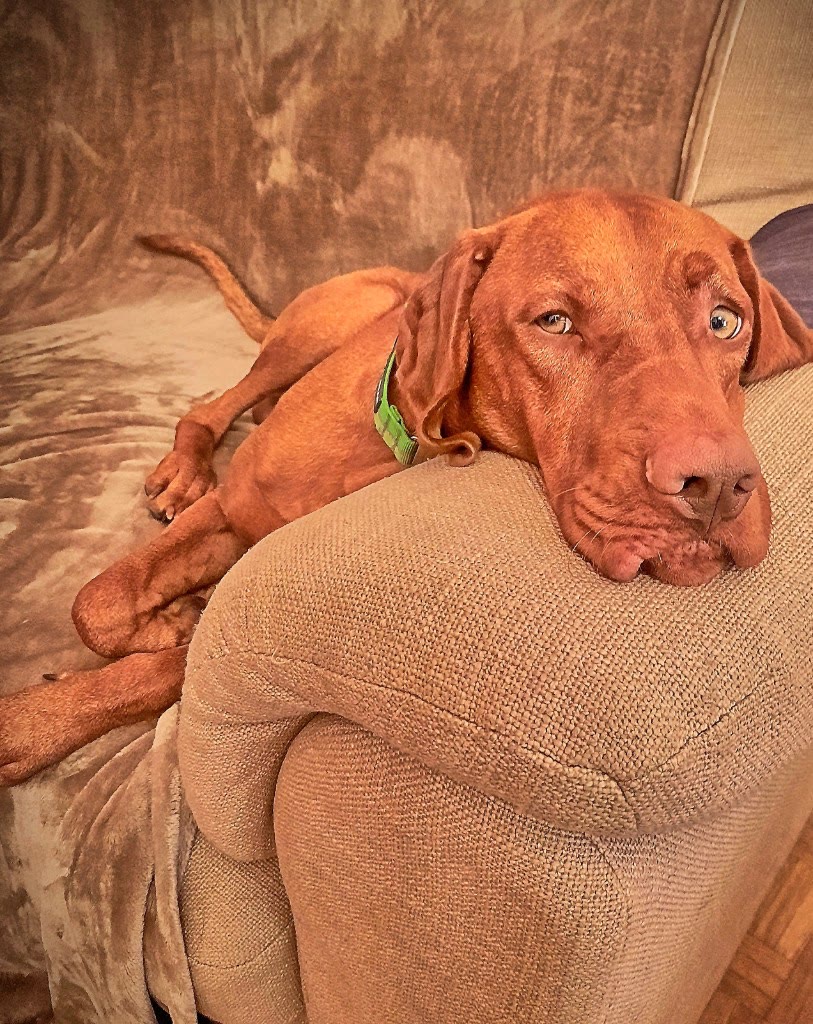
You may already walk long enough, yet your dog stays restless. Sniffing, making choices and contact with other dogs also ask something of your dog — and you often notice that at home.
You went for an hour’s walk, and an hour later your dog is back with a ball on your lap. Familiar? Often it is not about too few kilometres, but about too little mental challenge. Dogs, like us, need tasks, discovery and variety.
Physically vs. mentally tired
Running hard beside the bike or walking tightly on a lead tires the muscles, but often leaves the head still full. Sniffing, puzzling, social play and new environments, by contrast, activate the smell and decision centres — that costs energy in a different way. Duranton & Horowitz (2019) showed that nosework makes dogs more optimistic; more on that in our article about off-leash vs. on a lead.
What you can do yourself
- Let your dog sniff for at least half of a walk — without pulling.
- Vary routes: new smells = new stimuli.
- Use food puzzles or hide toys at home.
And if you have little time during the day?
A full group day trip can combine mental and physical tiredness when you cannot free up hours yourself; a shorter group walk does that in a lighter part of the day. How that differs from a normal walk on a lead is in our comparison article. Live in or around the city? See day trips or group walks.
Interested in day trips?
Adventurous day trips with home pickup — €45/day (excl. VAT). During the intro we check together whether your dog fits the group.