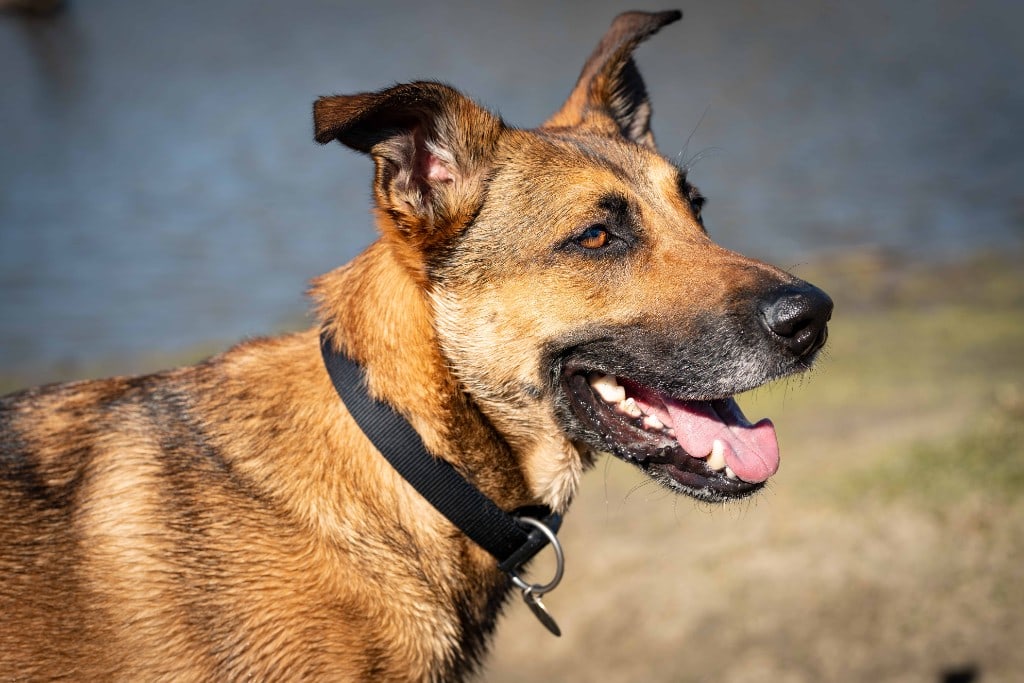
On a lead remains the foundation. A shorter group walk or a full day trip adds sniffing, own pace and social contact — with a clear difference in intensity.
Many owners notice their dog is still restless after a walk on a lead. That rarely means you “didn’t do enough kilometres”. More often the walk misses the right kind of stimulation: sniffing at their own pace, freedom of movement where it is safe, and social contact with other dogs. One Happy Hound has two group formulas for that — the same basis (group + pickup), different duration.
What a walk on a lead does well
Daily lead walks remain the foundation: toilet routine, bonding with you, orientation in the neighbourhood and mild exercise. That does not disappear when you choose a group formula — they complement each other. For calm dogs or short days, a solid neighbourhood walk is often enough. Problems arise especially with high-energy dogs, young dogs or social breeds: the same route on the same lead yields few new smells, few choices and few companions.
What research says about sniffing, pace and social contact
Three mechanisms keep coming back. First sniffing: Duranton and Horowitz (2019) showed that dogs who regularly do nosework respond more optimistically in a cognitive bias test than dogs who mainly do obedience exercises. More “foraging time” with the nose is linked to better welfare — not only to more steps. Second, own pace: GPS research on off-leash dogs (e.g. Hauser et al., 2021) shows that dogs move more varied and often further under their own steam than their owner sets on a lead. Third, social contact: dogs are social mammals; compatible companions reduce stress behaviour compared with isolation (classic work on socialisation and shelter studies on group housing).
Important nuance: that does not prove “more is always better”, or that every dog must be off-leash for hours every day. It does explain why a short neighbourhood lead walk and a guided group outing in nature can have a different effect — even when the clock time of the shorter group formula is closer to a long walk.
“By giving dogs more time to use their sense of smell and make their own choices, they become on average more optimistic — that is different from only adding kilometres.”
Two group formulas at One Happy Hound — same idea, different intensity
Both formulas are group outings with pickup and return. Not a solo walker looping the block. The difference sits in duration and how “full” the day is.
- Group walk (Formula 1, Greater Antwerp, waitlist): max. 7 dogs, 1.5 to 2 hours, morning or afternoon. Partly on a lead, partly off where safe — matched to location and group. Shorter part of the day, still group + nature beyond the neighbourhood.
- Group day trip (Formula 2): full day in nature, usually 6–10 social dogs, pickup and return included. More cumulative movement, sniffing, rest moments and social contact across a whole day.
So the shorter formula is not a “classic individual walk”. It is a group outing in a defined part of the day. What you should not expect from it: the same deep evening tiredness as after a full day. What you may expect: more smells, more choice and companions than a typical city lead walk — provided the group and the route are right.
Three options side by side
- On a lead (you): basic routine, bonding, neighbourhood. Limited sniffing at own pace; little or no stable group mates.
- Group walk (~1.5–2 h): guided group, beyond the neighbourhood, mix of lead/off-leash. Mental and social boost in a defined part of the day — realistic if you do not need or want a full day.
- Group day trip (full day): maximum sum of movement, nosework, play and rest. Often visible in a calmer evening — not magic, just more hours of the right stimuli.
Who suits what?
Keep walking on a lead: that remains the daily backbone. Choose a group walk if your dog needs more social and nature stimuli than the neighbourhood gives, or if you want a shorter, fixed part of the day. Choose a group day trip if your dog has lots of energy, is alone at home during the day, or if shorter walks structurally fall short. Unsure? Start from what your dog does afterwards: still hyper and searching, or relaxed and content. More about group day trips and group walks in Antwerp. The deeper research on off-leash walking and sniffing is in our article dogs off-leash vs. on a lead.
Sources
- Duranton, C., & Horowitz, A. (2019). Let me sniff! Nosework induces positive judgment bias in pet dogs. Applied Animal Behaviour Science, 211, 61–66.
- Hauser, H., et al. (2021). Exploration Behavior of Pet Dogs During Off-Leash Walks. Animal and Veterinary Sciences, 9(6), 181–190.
Interested in day trips?
Adventurous day trips with home pickup — €45/day (excl. VAT). During the intro we check together whether your dog fits the group.